Stick Insects
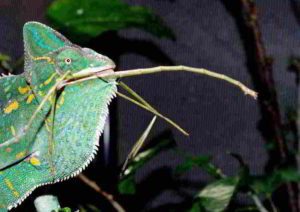
Stick insects are nutritious as long as they are not feeding on poisonous plants. As a feeder food they have one big advantage – when a colony is breeding well it can produce lots of individuals. A single female Phoebaeticus serratipes can lay hundreds of eggs.
The downside is that the eggs can take a long time to hatch. Also, some species have nasty spikes which can damage a chameleon’s tongue. Although their camouflage seems excellent chameleons seem to find them quickly.
As a food item for chameleons, stick insects are not the best. If you’re already breeding them, use the surplus but it doesn’t make sense to start breeding the specifically for food.
Housing & Temperature
A large airy cage is needed, sufficiently tall that the stick insect can hang down when changing skin. Branches of the food plant can be put in plastic water bottles to keep the food fresh, so the cage must be tall enough to accommodate the bottle and the branches. Plug the mouth of the bottle to prevent the stick insects walking down the stems and drowning in the water.
Most stick insects will thrive at room temperatures, between 22°C and 27°C (72°F – 80°F). Indian stick insects will breed well at lower temperatures, for example 18°C (65°F).
Feeding Stick Insects
Each species has different requirements for food in the wild but, in captivity, many will accept bramble, rose and oak. Others will eat privet, eucalyptus and even ivy. A few species are so specialised that they will refuse anything but one type of plant.
In northern Europe, bramble is used extensively as it is widely accepted by most common species and leaves can be found even in the hardest winters.
Most species benefit from a light spray every few days but check as a few dislike high humidity.
Life cycle
A stick insect hatches from an egg and goes through several skin changes until it reaches adulthood. In some species, there is little difference between the younger stages and the adults. Other species exhibit strong sexual dimorphism even before becoming an adult, with the male nymphs often being thinner and having more obvious wing buds.
For many species, a male is not always necessary for the successful production of fertile eggs. Mostly, mating is as simple as putting a male in with the female.
The eggs of most stick insects are just dropped by the female, to lay among the leaf litter until they hatch. Females of some species will push the eggs into the soil with strong ovipositors and a few glue their eggs along branches or under leaves.
Some species will hatch in as little as two months but most take around four to six months, with a few species only hatching after more than a year.
Room temperature is normally good enough for hatching eggs but anything between 20°C and 27°C (68°F – 80°F) should work well.
There are several types of containers and methodologies used to hatch eggs. The following system works for the species I feed to my chameleons:
Line a 5 litre plastic box with several layers of paper kitchen towel. Make of a lot of holes, about 4 mm (0.15″) diameter, in the lid of the box. Place the eggs on the paper towel and spray lightly once every few days.
To learn more about how to keep a good supply of nutritious insects on hand for your chameleon, check out this book: Breeding Insects as feeder food